Secure Private Cloud & IaaS – your sovereign cloud infrastructure
Cloud capabilities without giving up control over infrastructure, data or operating model
sayFUSE Secure Private Cloud & IaaS combines compute, software-defined storage, virtualisation and virtual network services into a controllable, sovereign cloud infrastructure. The cloud infrastructure can be deployed in your own data centre, in a customer-owned environment or in a contractually and technically controlled data centre. This allows organisations to retain control over the operating location, infrastructure, data and access models.
Unlike conventional public cloud models, in which infrastructure and operating processes are largely dictated by the cloud provider, sayFUSE Secure Private Cloud lets you shape the cloud environment on your own terms. Organisations define their own administrator roles, tenant boundaries, resources, security policies and compliance requirements.
Cloud functionality without loss of control: the infrastructure stays where it belongs – under your authority.

Sovereignty at every level
Control over operating location and data residency
The cloud runs on a dedicated sayFUSE HCI infrastructure. Data, metadata and workloads remain within the defined and controlled operating environment. Access paths, responsibilities and external connections are deliberately specified, controlled and documented. This keeps it transparent where data is processed, who can access it and which external connections exist.
Cloud resources without new infrastructure silos
Virtual machines, storage capacity and network services are provided centrally from a shared platform. Functions such as high availability, live migration, backup, live synchronisation and Post-Zero-Trust access can be integrated modularly.
New requirements and services can therefore be implemented without building and operating a separate infrastructure silo for each function. This reduces complexity, operating effort and dependencies – while delivering a high degree of flexibility and scalability.
IaaS with tenant isolation and self-service
Departments, units of public authorities, projects or customers can be managed as separate tenants isolated from one another. Each tenant receives defined roles, resource quotas, virtual networks and approved services. Authorised users can request standardised infrastructure services themselves, while central policies and capacity limits remain in place.
- Provide virtual compute resources and workloads per project
- Allocate software-defined storage according to capacity and performance requirements
- Integrate tenant networks, security zones and controlled transitions
- Manage roles, projects, quotas and administrative boundaries centrally
- Move existing systems across via live migration and keep them running
Secure Cloud
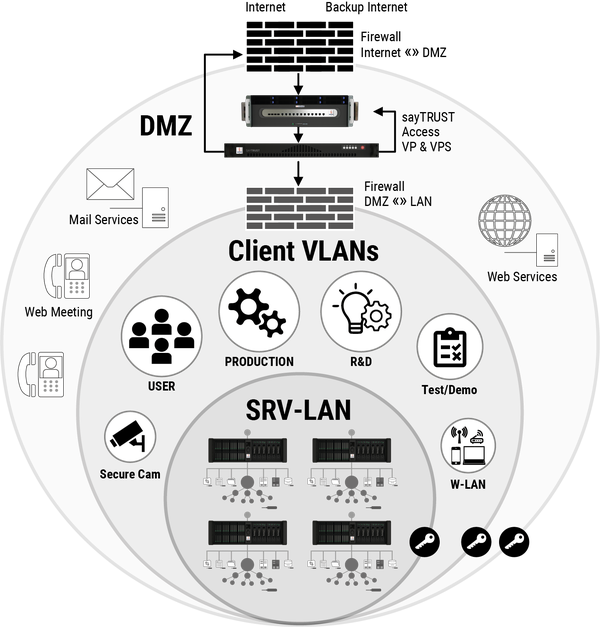
The SAYTEC architecture concept is divided into three vault zones. The innermost vault zone contains the physical infrastructure. The Secure Cloud is located in the outer vault zone. Within it, Network as a Service encapsulates the tenant and security networks as the middle vault. Applications, data and identity-bound access form the secure core.
Hybrid connection and connectivity without loss of control
Public cloud services and external sites can be connected securely via defined gateways and specifically approved communication relationships.
The Secure Private Cloud remains the controlled starting point for all external connections. Instead of far-reaching network couplings that are hard to control, communication paths are specifically defined, segmented and managed traceably.
The result is a hybrid infrastructure that enables connectivity without relinquishing control over network, data and access.
Typical areas of use
- Public authorities and public-sector organisations with high sovereignty requirements
- Industrial companies with sensitive production and development data
- KRITIS-related environments and regulated organisations
- Data centres and service providers with controlled customer environments
- Companies that want to expand their cloud functionality step by step
Economic benefits
The cloud infrastructure is sized to current requirements and expanded with additional nodes, capacity and services. Investment grows in line with actual use. A shared operating base reduces interfaces, parallel management systems and the effort of permanently operating and administering separate infrastructure silos.