
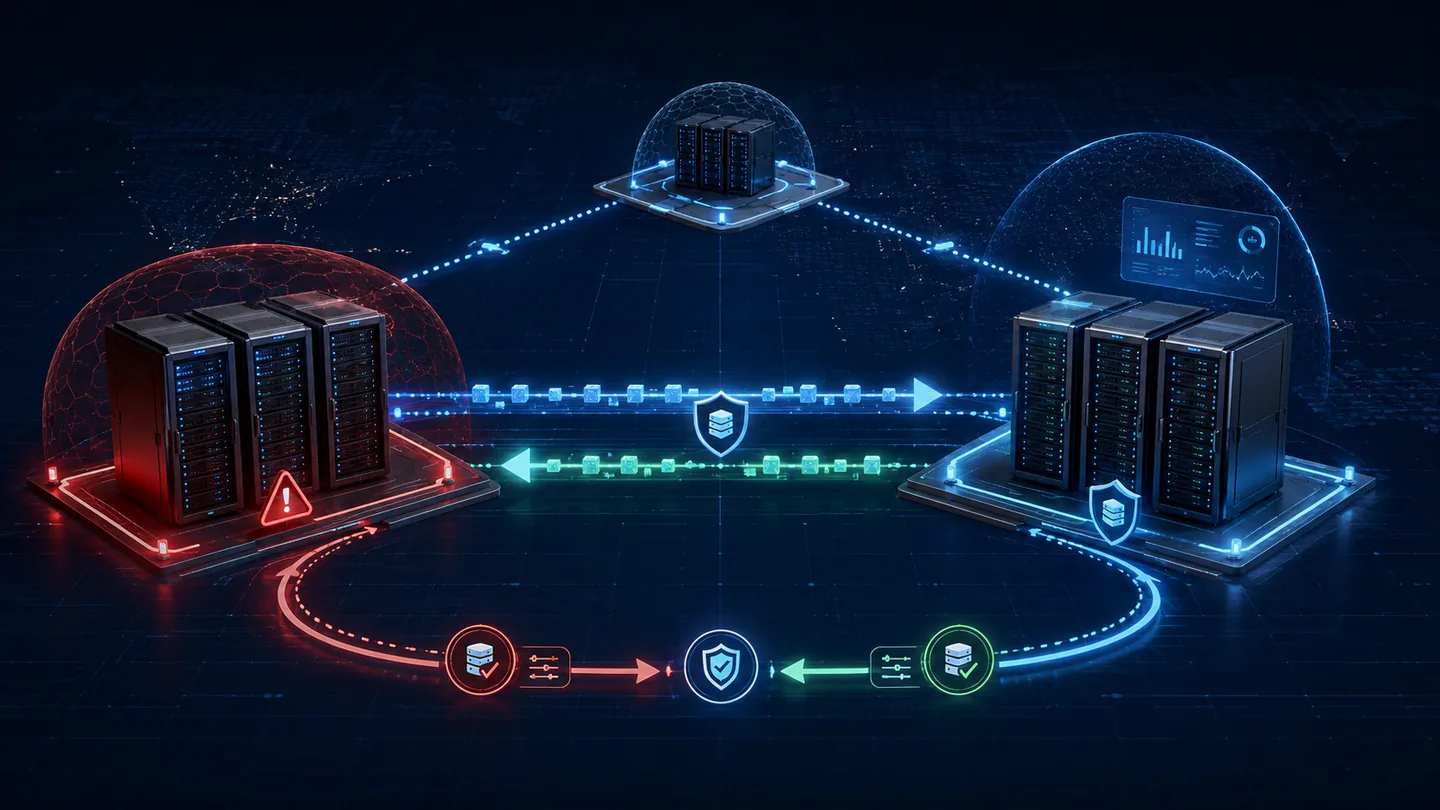
Live Sync & Live Migration
Migration and Synchronisation Without Lengthy Downtime
Transfer existing systems in a controlled way and protect critical workloads permanently.
Live migration and live synchronisation address two different tasks:
a) transferring existing production IT systems to a new infrastructure without changes and without lengthy downtime, and
b) protecting critical systems permanently against failures.
It makes no fundamental difference whether these are physical bare-metal systems or virtualised environments. The existing production system remains in operation, unchanged, throughout the migration and is transferred to the new target environment – a migration that does not interrupt day-to-day business for the duration of the transfer.
Live migration – transferring existing systems to a new platform without changes
During the initial migration, the source system remains in production. Changes made during the transfer are continuously synchronised to the target system.
The migration is only completed once the source and target systems are fully synchronised. The next step is to verify that the migrated system works completely and without errors on the new infrastructure and that all required workloads are properly available. Only after successful verification is the original system shut down.
This allows physical and virtual server landscapes to be transferred in a controlled manner to new HCI, private cloud, virtualisation or data centre platforms without having to change the existing production system beforehand.
Live migration licensing is limited to the duration of the respective migration project. The licence costs per migration licence are extremely low and are only incurred for the period of the respective migration.
Live synchronisation – permanent protection for critical systems
Live synchronisation, by contrast, pursues a permanent objective. Business-critical and operationally critical systems are kept continuously in sync with a second, separate infrastructure. After the initial synchronisation, complete datasets no longer have to be transferred over and over again. During operation, essentially only the changes that occur are transferred as small deltas, which keeps the additional load on the existing network bandwidth low. The Live Sync licence is used permanently, because synchronisation remains an ongoing part of the operational and cyber resilience strategy.
Why backup alone is not enough for critical systems
A reliable backup is indispensable. However, it does not automatically answer the crucial question:
How long does it take until a failed production system is actually up and running again?
If hardware or an entire server fails, it is not enough for the data to have been backed up. First of all, a suitable operating platform has to be available again.
Depending on the environment, spare parts or complete server systems have to be procured. In public authorities, public institutions or larger organisations, this may also require approval, procurement or even tendering processes.
This is followed by delivery, installation and configuration of the new hardware, restoration of the system from the backup and the subsequent technical verification.
Even with an existing backup, it can therefore take hours, days, weeks or, in the worst case, even months until production operations are fully resumed. For business-critical systems in particular, this time window is a problem.
In addition, conventional backups are often run in defined time windows – at night, for example – to minimise the impact on ongoing operations. If a failure occurs during the working day, the last backup may therefore be older than the current production data.
Live Sync shifts the critical moment
With permanent live synchronisation, a second, up-to-date and fully prepared operating environment is already available before a failure occurs.
If a critical system or a defined group of systems fails in the production network, the synchronised environment can take over its function. After a defined verification and switchover phase – depending on the architecture, within a few seconds to a few minutes – operations are started on the synchronised environment.
The crucial point is this: the data is synchronised continuously until immediately before the failure.
For users, applications and connected systems, the replacement environment functionally takes the place of the failed system. A production environment is therefore available again for day-to-day business within a short time. Restoring the original system is no longer the critical time factor for operational readiness.
Repairs without production pressure
While employees continue working on the synchronised environment, the original infrastructure can be restored without immediate time pressure.
Administrators can, for example:
- analyse and replace defective hardware,
- procure and install new systems,
- rebuild operating systems and applications,
- restore the last backed-up state,
- verify and approve the restored environment.
Meanwhile, the production data continues to evolve on the Live Sync environment. As a result, there is no data gap between the time of the original system failure and the infrastructure restored later.
Controlled resynchronisation to the original system
Once the original or newly built production platform is fully available again, the current data generated during replacement operation is synchronised back. To do this, the existing backup can first be transferred to the restored infrastructure; Live Sync then synchronises only the changes made since then. As soon as both environments are fully in sync again and the original production platform has been successfully verified, the controlled switchback takes place.
Live Sync can then run in its original direction again, continuously synchronising the production systems to the resilience or disaster recovery environment. This keeps the data consistent throughout the entire process – from the original failure through replacement operation to the restoration of the actual production environment.
From hours or days to just a few minutes of downtime
The decisive advantage therefore lies not only in the speed of data transfer. Without live synchronisation, resuming operations may depend on procuring spare parts, delivering hardware, installation and restore.
With live synchronisation, this time window is reduced to the defined verification and switchover time of the prepared replacement environment.
While repairs or new procurement may take hours, days or considerably longer in the background, production operations can continue on the synchronised infrastructure after a short time.
From migration to lasting cyber resilience
Live migration and live synchronisation can be combined directly.
Existing physical or virtual systems can first be transferred to a new infrastructure with a cost-effective, time-limited live migration. Particularly critical systems are then kept continuously in sync with a second data centre, disaster recovery site or resilience platform through permanent live synchronisation.
The goal: migrate existing systems to a new infrastructure without changes and without unacceptable downtime – and then protect particularly critical workloads so that a hardware, system or site failure no longer leads to a prolonged standstill of business operations.